
- Barry Villaverde
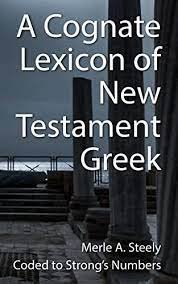
This book by Merle A Steely is an excellent Bible Study Tool for the student who has some familiarity with the Koiné Greek language.
A standard Greek-English lexicon is designed to provide you with an alphabetical listing of every Greek word in the New Testament (alphabetical by the Greek alphabet). In addition, English definitions will be supplied, often along with the lexicographer’s understanding of that word’s semantic range. These lexicons are very helpful Bible study tools. But this book is NOT a Greek-English lexicon.
To understand the value of this book, it might be best to understand what a “cognate” is in this context. A Greek cognate is a word that shares the same root or family as another Greek word. To put it another way, Greek words are often from a family of words which share the same root. Each word in this family is called a cognate.
This cognate lexicon is designed to provide a complete vocabulary of New Testament Greek that is arranged around the root. It is also arranged alphabetically – but not by word such as in a Greek-English lexicon. Rather, it is arranged by the root of the various word families included in the New Testament.
This is remarkably useful for students of the Greek New Testament, especially when doing word studies. Let’s say you were doing a study of the primary word most often translated “love” in the New Testament – namely, the noun ajgavph (agape). Now, if you are able to research this word and see how it is used in every instance it is found in the New Testament, then you have gone a long way in understanding the word and how God used it. But, in truth, you will have fallen short in understanding because you would have left out pertinent information. You see, ajgavph comes from the root – agap and there are two other Greek words in the New Testament that share that root – that are cognates of ajgavph. There is the Greek verb ajgapavw (agapao) and the Greek adjective ajgaphtovV (agapetos). To be more thorough in your word study, you would want to (a) know what the cognates and root are of ajgavph; (b) find every instance of all three words in the New Testament; and (c) work to understand the semantic center and semantic range of each. Even then, that’s just part of what’s involved in a word study. Nevertheless, this book, A Cognate Lexicon of New Testament Greek, will help you to find a word’s root and its cognates so that you have a proper starting point in your Greek word studies.
And, if that isn’t enough incentive for you to find it and buy it, consider this. As of this writing, this extremely beneficial book can be found in paperback form on Amazon for under $7. And to sweeten its value, Mr. Steely has placed it in the public domain. That is, any ideas in it or portion of it may be freely copied and used by anyone as long as it is for a non-profit purpose with no prior permission required.
As a Bible study tool, I give this book a very strong recommendation. Make it a part of your library and then use it – you’ll be thankful you did.