


I Peter
Author: The apostle Peter, 1Pet.1:1. A fisherman of Galilee along with his brother Andrew, Peter was chosen by Jesus to be one of the twelve apostles, Mt.10:1-3. Peter was a married man, Mt.8:14; 1Cor.9:5. Scripture reveals him to be sincere, courageous, outspoken, unstable, even impetuous at times. But the Lord used him to accomplish great things in His service. When he wrote this epistle Peter was in Babylon with Mark, 1Pet.5:13. Whether this was literal Babylon on the Euphrates River or a figurative reference to Rome or some other place has been a matter of much dispute. The Bible doesn’t say how his life ended but some early historians write that he was crucified upside down. As an apostle of Christ what Peter wrote was inspired of the Holy Spirit, Jn.14:25,26; 16:13; Acts 2:1-4; 2Pet.1:18-21.

James
Author: James, Jam.1:1, one of the sons of Joseph and Mary and the brother (half-brother) of Jesus, Mt.13:55; Mk.6:33; M.1:18-23; Lk.1:26-35. There are several men in the Bible named “James.” A concordance and Bible dictionary will help one sort these out. Jesus’ brothers, including James, did not believe at first, Jn.7:3-5. But after his resurrection Jesus appeared to James, 1Cor.15:7, and James and his brothers waited in Jerusalem with the apostles for Pentecost, Acts 1:14. James became a prominent leader in the early church, Acts 12:17; 15:13;21,18-20; Gal.1:19; 2:9,12).


New Testament Word Study: Revisiting One’s Approach with Patience
The inaugural issue of the quarterly newsletter, The Scripture Student, Vol. 1, No. 1, contains an article I wrote entitled “Studying the New Testament with Patience: Digging Deeper.” The central point of that article is to emphasize that when studying a word in the Scriptures, our primary objective must be to understand what the original word means—not to place undue emphasis on what its English translation means. In this article, I want to expand upon that principle by offering some additional clarification and revisiting the study presented in the newsletter.
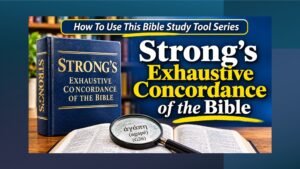
How To Use This Bible Study Tool Series: Strong’s Exhaustive Concordance of the Bible
Every Bible study tool is designed with a particular purpose in mind, and sometimes with several purposes. Some tools are especially effective at accomplishing a single task, while others provide assistance in achieving multiple objectives. Regardless, these tools become most useful when the student understands what they are designed to do and, just as importantly, how to use them effectively and efficiently.
The purpose of this series is to help students become familiar with various Bible study tools, understand their primary functions, and learn how to use them to their greatest advantage.