
- Barry Villaverde
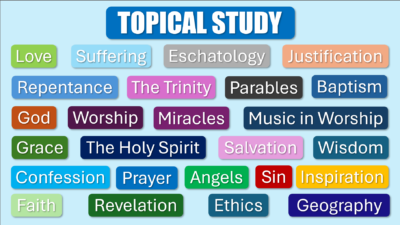
When you embark on a study of what the New Testament teaches on a particular topic, it can be quite the task. The topic may be so broad that it involves much more than anticipated – for example, more than one word family associated with that topic. And each word family may have multiple cognates that have to be investigated. In addition, each cognate may have a numerous number of verses to look up to see how the Holy Spirit inspired men used that word. Indeed, a proper topical study may take multiple months of work – but the spiritual reward is worth it. Let me share an example of what might be involved in a topical study.
Let’s say you wanted to study what the New Testament teaches about sin. If you were to look up the primary word for sin, you’d find aJmartiva which essentially means “a missing of the mark.” There are 174 instances of this Greek word used in the New Testament. That’s going to take some time to review how the Holy Spirit inspired men used this word.
But a good student would also want to study this word’s cognates (words that come from the same root). Investigation reveals that there is also aJmartavnw (found 43x), aJmavthma (found 4x), aJmartwlovV (found 47x), ajnamavrthtoV (found 1x), and proamartavnw (found 2x). Okay, now you’ve got your work cut out for you.
But a better student would also note that the New Testament doesn’t just use this word to potentially connote the sense of “sin”. You would also want to consider the following:
- The family of words often translated transgression such as in Galatians 3:19 (there are six Greek words that come from the same root and these words are found a total of 41x in the NT).
- The family of words associated with lawlessness/iniquity such as in Matt. 7:23 (there are six Greek words that come from the same root and these words are found 31x in the NT).
- The family of words associated with debt such as in Matt. 6:12 (there are seven Greek words that come from the same root and these words are found a total of 54x in the NT).
- The family of words associated with iniquity/wickedness/evil such as in Acts 3:26 (there are three words that come from the same root and these words are found 85x in the NT).
- The family of words associated with evil/bad such as in II Cor. 5:10 (there are 18 Greek words that come from the same root and these words are found a total of 121x in the NT).
- The family of words associated with err/wander such as in James 5:19-20 (there are 5 Greek words that come from the same root and these words are found a total of 57x in the NT).
- The family of words associated with blame/fault such as in II Pet. 2:13 (there are 4 Greek words that come from the same root and these words are found a total of 12x in the NT).
- The family of words associated with wrongdoing/iniquity/wickedness such as found in Acts 1:18 (there are five Greek words that come from the same root and these words are found a total of 68x in the NT).
- And in addition to all of these, there are at least three other words to consider that are found a total of 10x in the NT). And, incidentally, the list is longer, depending upon how you’d categorize.
After doing the work to research this, then the truly ambitious student might also want to study the various offenses in the New Testament that fall under these categories such as are listed in Galatians 5:19-21, for example.
Now, not every topical study is going to be this comprehensive, but this example serves well to illustrate that a topical study is not merely looking up a word in a Bible dictionary and thinking you know what the New Testament teaches on the matter. The thorough student will work hard to find everything the New Testament says on any topic and then spend the required days, months, years studying it. And, of course, if you want to know what the Old Testament teaches on the same topic, then you’ll go through the same process.
A good topical study is work, no doubt. But it is spiritually rewarding work. The Scripture Student is here to help you with your topical study. Come back from time to time and let us increase our ability, together, to be the best students we can be.