- Barry Villaverde
I don’t think it is an overstatement to say that, of all the Bible study tools I have collected over the years, these two companion volumes—and especially The Word Study Concordance—are the ones I have used more than any others in my Bible study toolbox. For the student who wants to look more closely at the words of God’s inspired Word, these books are invaluable.
What makes these two volumes so useful to the New Testament student? Let’s take a closer look at each one.
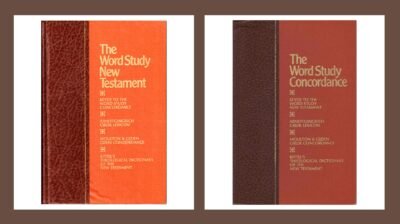
The Word Study New Testament
The New Testament was written in Koine Greek. Consequently, anyone who wants to study the New Testament more deeply must eventually come to terms with the language in which it was written. But what if you have never studied Greek? Does that mean you must limit your study to the English translations available to you? Not at all! This is where The Word Study New Testament comes to the rescue.
Using the King James Version, Ralph and Roberta Winter have incorporated the numbering system of Strong’s Exhaustive Concordance of the Bible throughout the text. Each noun, verb, adjective, and adverb is identified with a number corresponding to the Greek word underlying the English translation.
Why is this so helpful? The numbering system enables readers who do not know Greek to consult reference works that use the same Strong’s numbering system. Rather than simply looking at an English word and assuming that it represents the same Greek word everywhere it appears, students can use these numbers to investigate the original-language vocabulary behind the translation.
For those who have not studied Greek but want to gain a better understanding of the Greek words underlying the English text, The Word Study New Testament is an excellent starting point. It provides a practical bridge between reading an English translation and exploring the language of the original text.
The Word Study Concordance
As valuable as its companion volume is, I consider The Word Study Concordance even more useful. In fact, this is the volume I have found myself reaching for most often.
By its own description, The Word Study Concordance is a modernized, improved, and enlarged version of The Englishman’s Greek Concordance and The New Englishman’s Greek Concordance. To appreciate its value, it helps to understand how a Greek concordance differs from an ordinary English concordance.
A traditional concordance, such as Strong’s Exhaustive Concordance of the Bible, is organized around the words found in an English translation. A Greek concordance, however, is organized around the Greek words themselves. This distinction is significant because a single Greek word may be translated by several different English words, depending on the context. Conversely, the same English word may represent several different Greek words.
A Greek concordance allows students to trace a particular Greek word throughout the New Testament and examine how translators have rendered it in different passages. This can reveal connections and distinctions that might otherwise go unnoticed when studying only the English text.
The Word Study Concordance makes this kind of investigation accessible to readers who do not know Greek. It is keyed to The Word Study New Testament, allowing students to locate a Greek word by using the numbering system rather than having to recognize or spell the Greek word themselves.
But the usefulness of this volume does not end there. It provides a wealth of additional information to assist the serious Bible student.
For each Greek word, the concordance provides:
- The Greek spelling of the word, allowing students to see the actual word used in the New Testament.
- An English transliteration to help readers identify and pronounce the Greek word without having to read the Greek alphabet.
- The number of occurrences of the word in the New Testament, helping students appreciate how frequently it appears.
- References to major Greek-language research tools, including the page number where the word is discussed in A Greek-English Lexicon of the New Testament and Other Early Christian Literature by Walter Bauer, translated and edited by William F. Arndt and F. Wilbur Gingrich, in editions published before 1979.
- References to The Concordance to the Greek New Testament, edited by W. F. Moulton and A. S. Geden, providing another resource for tracing the word throughout the Greek text.
- References to Theological Dictionary of the New Testament, commonly known as Kittel’s, identifying the volume and page where the word is discussed.
- A Strong’s number for a suggested root word, providing another avenue for further investigation into the word’s relationship to other vocabulary.
These features make The Word Study Concordance much more than a simple list of biblical references. It serves as a gateway to a broader range of Greek reference works, helping students move from identifying a word to investigating its usage and meaning in greater depth.
Final Thoughts
If you are serious about becoming a better student of the Bible, I believe these two volumes deserve a place in your library. They are particularly valuable for students who have not studied Greek but want to look beyond an English translation and investigate the words of the original New Testament text.
Of the two, I consider The Word Study Concordance the more indispensable volume, largely because of the breadth of information it provides and the access it gives readers to other important Greek reference works. When used alongside The Word Study New Testament, it offers a practical way to begin exploring the original-language text without first having to master Greek.
One important caution, however: these books are tools for beginning and advancing word studies, not substitutes for careful exegesis. A Greek word’s meaning must be determined by examining its usage and context, not merely by consulting a concordance, identifying a root, or collecting definitions from lexicons. No single English equivalent necessarily captures a Greek word’s meaning in every passage.
Used properly, these companion volumes can help you ask better questions, investigate the text more carefully, and develop a deeper appreciation for the language in which the New Testament was written. For the serious Bible student, that makes them well worth considering.