- Barry Villaverde
If you simply learn the alphabet of a language, you have not learned the language. That is certainly true of Koine Greek, the language in which the New Testament was written.
So, if learning the alphabet is not the same as learning Greek, what possible benefit could there be in simply learning the Greek alphabet?
Good question. And good questions deserve good answers.
Consider these four benefits.
1. It Can Motivate You to Learn More
Many of the Greek letters look surprisingly similar to English letters. Because of this, the Greek alphabet is actually fairly easy to learn. If you are motivated, you can probably learn the letters in just a few hours—perhaps even less.
That may seem like a small accomplishment, but it can be an important first step.
Once you have learned the alphabet, you have begun to become familiar with the language used by the inspired men of the first century to write down God’s powerful Word. You may find that learning the alphabet sparks an interest in learning more Greek.
Sometimes, the first step is the hardest. Once you take it, you may discover that learning Greek is not as intimidating as you thought.
2. You Can Begin Using Greek-English Lexicons
One of the most useful Bible study tools available to students of Scripture is a lexicon.
A lexicon is essentially a vocabulary of a particular language—similar to a dictionary, but designed specifically for that language. A Greek-English lexicon, therefore, provides information about Greek words along with their English meanings and often much more.
Many Greek lexicons are arranged alphabetically according to the Greek alphabet, rather than the English alphabet.
Knowing the Greek alphabet makes it possible to find words in these resources for yourself.
You may not yet know how to pronounce the word, understand its grammar, or even know what it means. But if you can recognize the Greek letters and put them in their proper alphabetical order, you can begin taking advantage of the tremendous amount of information contained in Greek reference works.
That is a significant Bible-study benefit from learning something as basic as the alphabet.
3. You Can Use Steely’s A Cognate Lexicon of New Testament Greek
If you look through the book reviews on The Scripture Student, you will find a review of A Cognate Lexicon of New Testament Greek by Merle A. Steely.
This is an exceptionally useful Bible study tool for students who want to understand relationships among New Testament Greek words.
But there is something important to understand about using this resource: its arrangement depends upon the Greek alphabet. The words are organized according to the roots of Greek word families rather than simply being listed according to their English translations.
If you do not know the Greek alphabet, using a resource like this can be frustrating.
If you do know the alphabet, however, you can begin to take advantage of the information it provides.
If this resource is not currently part of your Bible study toolbox, I encourage you to take a look at it. And learning the Greek alphabet will make it much easier to use.
4. You Will Begin Recognizing Greek Words
Perhaps one of the most enjoyable benefits of learning the Greek alphabet is that you will begin to recognize Greek words.
You may encounter Greek words in an interlinear New Testament. A teacher may bring up a Greek word during a Bible class or sermon. You may see a Greek word in a reference work or look at the text of the Greek New Testament itself.
At first, the words may look like nothing more than a collection of strange letters.
But once you know the alphabet, something begins to change.
You can recognize individual letters. Then you begin recognizing combinations of letters. Eventually, you start recognizing entire words.
And before long, you may discover that you are developing a Greek vocabulary without even realizing it.
Consider one simple example:
θεός — theos — “God”
This is one of the most frequently occurring words in the New Testament. You will encounter it again and again. The more frequently you see it, the more familiar it becomes.
You may not yet understand everything about the word—its grammatical form, its case, its function in a sentence, or the nuances of its meaning—but you can recognize it.
And recognition is a beginning.
The more Greek words you recognize, the more comfortable you will become with the appearance of the Greek New Testament. What once looked completely foreign begins to look familiar.
And it all begins with learning the alphabet.
So, Will Learning the Greek Alphabet Help?
Absolutely!
Learning the Greek alphabet will not make you a Greek scholar. It will not enable you to translate the New Testament. And it certainly does not replace learning the language itself.
But it will give you a foundation for doing those things.
It can motivate you to learn more. It can help you use Greek lexicons and other reference works. It can open the door to valuable study tools such as Steely’s A Cognate Lexicon of New Testament Greek. And it can help you begin recognizing Greek words whenever you encounter them in your Bible study.
So why not give it a try?
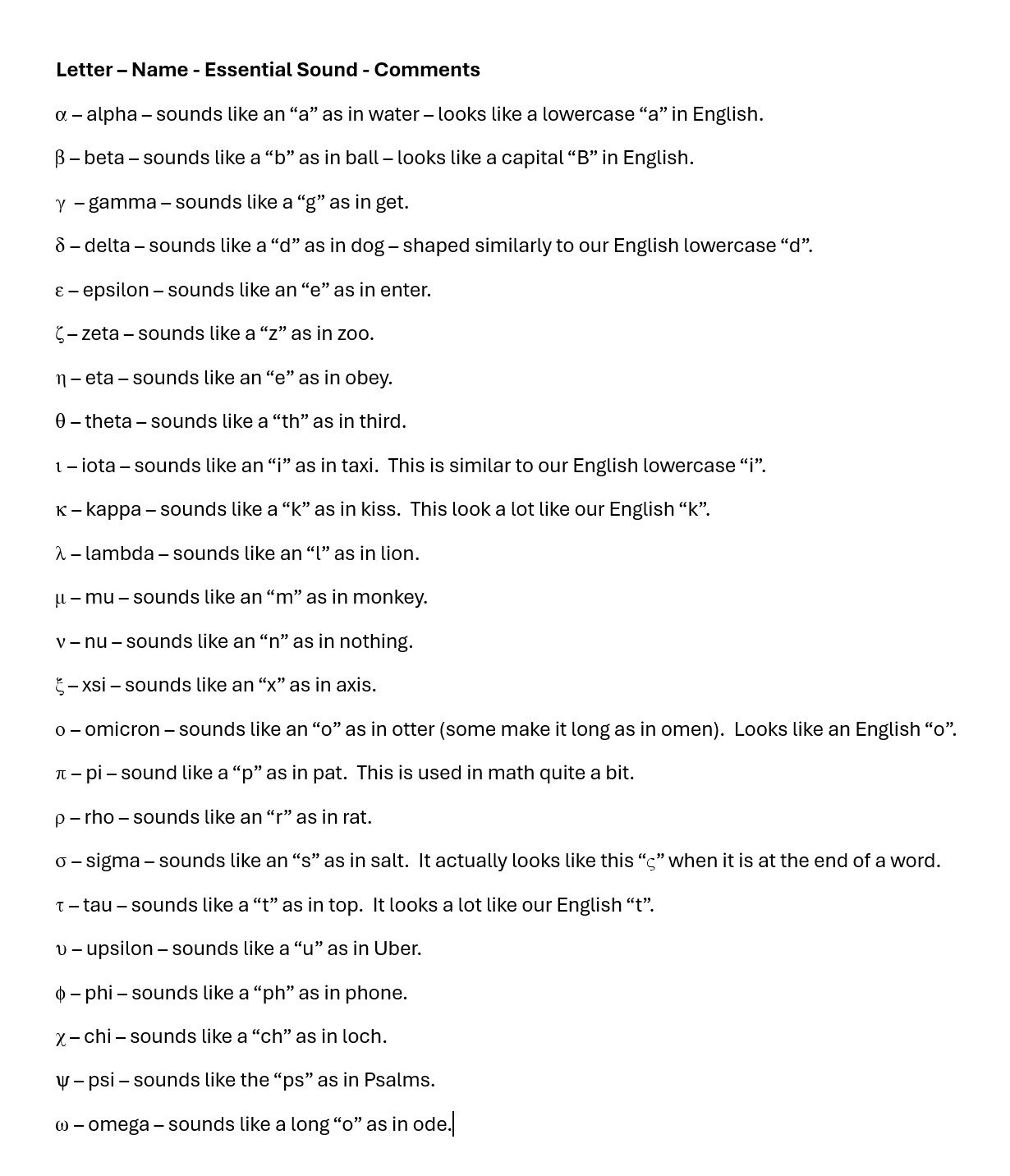
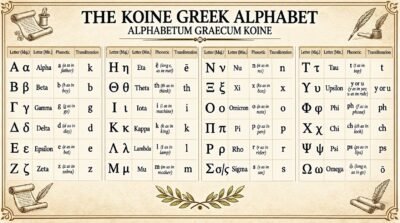
The English alphabet has 26 letters. The Greek alphabet has only 24.
Below are the lowercase letters of the Greek alphabet, their names, their basic sounds, and some additional comments to help you become familiar with them. The goal is not to learn everything at once. Start with a few letters. Memorize their names and basic sounds. Practice writing them. Then come back and add a few more.
Before long, you may discover that you have learned the entire alphabet.
And once you know the alphabet, you have taken your first step toward learning the language of the New Testament.
It may be a small step—but it is a step worth taking.