
- Barry Villaverde
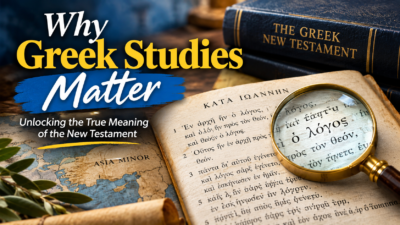
Koiné Greek – Why?
“You don’t have to know the Greek!” is something I’ve been told by many people over time, including gospel preachers, in the context of studying the New Testament. While I do not agree with your “everyday” Christian (if you will) who makes that claim, I at least understand it. But when a gospel preacher boldly proclaims such a thing, that I don’t understand.
These same gospel preachers require a “Thus saith the Lord,” and yet none of the New Testament writers wrote in English when writing the Lord’s will. These same gospel preachers correctly point out that you must study your Bibles in context, but then completely ignore the grammatical context by eschewing Greek (how can you study in context when ignoring the most important context – the very words the inspired writer wrote?). They emphasize the point by using such phrases as, “You must put on your first-century glasses when studying the New Testament,” while at the same time they stick with twenty-first-century glasses when it comes to the very words that make up the New Testament. Make sense of that if you can.
After Jesus came, lived, taught, was crucified and resurrected, and ascended to heaven, God inspired a number of men to write His New Covenant for all of mankind—what you know as the New Testament. These inspired writers wrote it in the common language of the day—namely, Koiné Greek.
Like any other language, Koiné Greek has its own nuances, idioms, vocabulary, grammar, and so forth. And it does not matter how talented you may be as a translator; there will be something lost in translation. Don’t believe me? Try it yourself. Immerse yourself in learning Koiné Greek, and in a short time, you will realize how true that statement is.
Do we have good English translations of the New Testament today? In my humble judgment, I say, “Yes!” We do. They are helpful—no doubt about it. In fact, I can prove you can learn how to become a Christian with a good translation.
But make no mistake: the New Testament IS the Greek New Testament. God did not inspire men to write the New Testament in English (or French, or German, or whatever your home language may be, for that matter).
Is something lost in all these translations? Yes, there is.
In fact, may I suggest that a translation of the Greek New Testament is God’s Word only insofar as the translation accurately reflects the original Greek? If a translation does not accurately reflect the original Koiné Greek of the New Testament—God’s Word—how can it then be God’s Word? (note: I’m not saying it has to be a literal word for word translation of the Greek but it must accurately reflect what it says).
Similarly, though not completely parallel – have you ever had someone paraphrase something you said, claiming that it was what you said…though it was clearly not what you said. You may have even chastised that person for making such a claim. They may even have gotten some of it right, perhaps even close to the sense of what you said, but they did not accurately reflect what you said.
This is the point. And that’s with your words or my words. How much more important is it when it comes to God’s Word when our very lives depend upon it.
In a sense, depending upon a translation of the New Testament is depending upon another’s interpretation of the New Testament.
Reflect on this.
What Can We Do About It?
I’d like to encourage you to start studying Koiné Greek. We are living in a day and age when the number of FREE resources available to you to help you learn this language is so great that I couldn’t accurately quantify it.
You can do it. I know you can. It’s just a matter of you knowing that you can and then following up.
The Scripture Student is here to help you with those studies by sharing lessons from time to time associated with the Koiné Greek New Testament.
Come along, and let us learn together.